


This is the first part of a two-part essay on the history of the queering of the so-called ‘intersex’ movement. From the sexologists who studied ‘hermaphrodites’ as a way to understand transsexualism, to a patients’ rights advocacy movement, to its current incarnation: a Trojan Horse for queer identity politics that is having a real effect not just on the status of sex in law, but also on the treatment of children born with disorders of sex development. I didn’t choose the topic randomly: thanks to activism by intersex organisations, the Council of Europe has instructed all member countries to allow informed consent-driven gender-affirming care for children — ‘intersex’ or not.
Here’s the first part of that history.
If you appreciate my work, I can keep going if enough people take out a paid subscription. I want to quit my day job so I can do this research full time (and say some things that are currently unsayable because of a sensitive employment situation). Your support means everything!
Fair warning: the second part of this article will be paywalled.
It’s April, 1993. Waco, Texas is a-siege. The UN has just told Bosniaks to hunker down in the safe space of Srebrenica to wait out the war, and Monica Seles is getting stabbed by Steffi Graf’s stalker on a German tennis court. Meanwhile, a carful of transsexuals is making its way across the un-undulating Dutch flatscape to Amsterdam’s Free University for a conference called “Transsexualism, medicine, and the law”.
Back home in the UK, from whence our protagonists have just flown, the number one song in the music charts for the entire month was “Young at Heart” by a Scottish pop troupe called The Bluebells.
What a fitting ditty for the road trip.
It’s a joke, you see, that someone could, despite their chronologically-worn physical reality, have a heart that has not aged at the same pace as the rest of their meat suit. Or perhaps, one could have a soul age and an actual age but the twain are at odds. A hoot of a concept.
And yet among the passengers of that Dutch rental car were some of the world’s most dedicated fangirls and boys of a theory similar to — and just as implausible as — the soul-age gag. They were Stephen Whittle, a stone-butch working class lesbian, and her perma-costumed compadre, Christine Burns, a garishly made-up Tory autogynephile.
The year before, in 1992, Whittle and Burns had founded a transsexual activist group whose mission was to force the UK government to allow them to manifest in the public sphere something they felt deep down in their guts: that they were trapped, erroneously, somehow, in the bodies of the sexes they were not.
Other activists in Europe had likewise been attempting to convince their domestic courts of this cosmic switcheroo. Having failed, they had turned their attention to snitching to mom and dad in Europe: our legal jurisdictions are being mean, they petitioned to the court-of-last-resort, the European Court of Human Rights in Strasbourg, France.
But the Strasbourg court couldn’t overrule national decisions willy-nilly. Besides, what even is transsexualism? they wanted to know. Thus the 1993 Amsterdam conference, where the activists were headed, had been requested by the legal department of the Council of Europe in order to establish, once and for all, whether or not legal gender recognition should be considered a human right and thus codified in law.
The born-this-way intersex brain
One of the arguments that European countries had used to reject requests to falsify sex on legal documents was that they considered being transsexual a personal choice. And a team of doctors at the gender clinic attached to the Free University, where that April 1993 event was to take place, were among the biggest allies in the fight against this claim.
One of those doctors, endocrinologist Dr Louis Gooren, had spent years working on locating biomarkers that could prove the biological etiology of transsexualism. His working theory was that it was a kind of intersex condition of the brain.
Gooren, who had been crowned the world’s first chair of transsexuality in 1989, had turned his lab notes into lay language for the big closing speech at the event, in which he hoped to convince everyone of the ‘born-this-way’ brain.
Sometimes, he would tell the gathered, hormonal activity sends the foetal brain off track from the rest of the baby’s body — particularly the intimate bits. And this intersex-like brain-bollock mismatch results in the phenomenon we call transsexualism, which manifests as a strong feeling of incongruence between one’s body and sexed reality.
However, by 1993, Gooren, who had been working on this topic since the early 70s, was starting to sound to the activists like a relic of the old school.
The 1990s were a period of rapid change in the universe of trans rights activism. Immersed as he was in that milieu, it’s hard to imagine he didn’t know that many transsexuals had begun to sour on the idea of finding any kind of biomarker — brain-based or otherwise — that would explain what ailed them.
In fact, transsexual activists had begun to ask: was it really necessary to claim that anything ailed them at all?
The rise of muh rights
It was the advent of two eras: the era of human rights activism overreach, and the era of queer.
‘Human rights’, it increasingly seems to me, allows you to recast your desires as fundamental entitlements as long as you can feed ‘norm entrepreneurs’ — like the people working for supranational judicial and soft-power systems like the ECHR and UN bodies — a decent enough sob story. The more novel your victim fantasy, the more tickled their progressive bellies.
Queer theorists in academia, meanwhile, had begun sharing their findings with the world, and they were deep: nothing is real or knowable, and everyone’s a bit of a perv when it comes down to it.
The truth was looking less relevant than ever.
Scrap the scans, the transsexuals had begun to demand. Can’t I just be the opposite sex because I say so? They sought to move away from tying their plea for identity-based rights to hypotheses about biology, despite the fact that the entire field of transsexualism — including the gender teams upon whose legitimacy activists were leaning for support — had always been a medical affair.
Poor Louis Gooren. He got up to the lectern hoping to share his enthusiasm for the bed nucleus of the stria terminalis, while the very people he sought to save had already turned on his treasured theory.
Going to Strasbourg
The first court case concerning a transsexual had appeared on the docket of the European Court of Human Rights in 1979. It was brought by a posh young woman (plus ça change) who had been pretending to be a man since 1966.
Raised in the fancy Brussels neighbourhood of Uccle, Danielle Van Oosterwijck was working as a civil servant in the European Commission when she underwent a European taxpayer-funded ‘ten-stage’ phalloplasty at a London clinic (ten-stage is a euphemism for ‘things went horribly wrong’).
Van Oosterwijck had a neurologist and an endocrinologist diagnose her with ‘la transsexualité’ and this was the basis of her claim that she had been incorrectly recorded as female at birth. She sought to make use of a law that allows corrections of errors on civil documents. The Belgian court found no evidence of an error, so her lawyers then appealed to their sense of ‘equity and humanity’, which also didn’t work.
It went to Strasbourg, but her application was rejected for a stupid reason — she hadn’t gone through all of Belgium’s judicial options first. So we never got to find out what the ECHR judges thought about her request to force everyone to pretend she was male.
But the steady stream of applicants who came after Van Oosterwijck had their paperwork in order and they got denied on the basis of (I’m paraphrasing)WTF get outta here.
However, a year before the Amsterdam conference, in 1992, the Strasbourg judges finally showed signs of yielding to pressure. After years of rejecting claims — mostly from British applicants — that it’s a breach of someone’s privacy not to force the public to go along with one individual’s delusion, the judges gave up and told France that they had interfered in the private life of a man, known only as “B”, by not officialising him as female.
However, the judges couldn’t settle on how to remedy this (newly-designated) human rights outrage. (The ruling came with no small amount of dissent from a number of the judges — with particularly glorious TERFy comments from a Portuguese judge, who refused to call B a woman).
The squabbling didn’t actually matter in that individual case: France, being all about that postmodern bullshit, gave the man what he wanted anyway without further finger-wagging from Strasbourg required.
But the ECHR knew the issue wasn’t going away, which is purportedly why the Council of Europe invited Gooren and his transsexology pals, along with activists like Whittle and Burns and a whole host of other stakeholders, to nail down what this phenomenon was, and how to deal with the growing number of legal appeals to identify as it.
The problem with brain research
In his self-congratulatory memoire, published in 2013, Christine Burns revealed, when remarking on Gooren’s intersex-brain speech, that it had already been decided that it was time to diverge dramatically from the clinical view of transsexualism.
According to Burns: “(Gooren’s) speech went on to explain the process of human sexual differentiation from the moment of conception, and to elaborate on the Dutch team’s recent research on the physical signs in the brain — a subject which later became contentious in trans campaigning as people came to different conclusions on how much weight to accord to such research.”
He continued: “Were people to campaign for trans rights on the basis of contestable physical evidence claiming that trans people were measurably different with some kind of ‘intersex’ condition? (Gooren used that word) Or should the case be made on the purely human rights basis that trans people exist?”
It shouldn’t matter how we got like this, and why our brains are organised the way they are, Burns was saying, so put your bloody calipers away! The courts should recognise us as our chosen sex because it’s the human-rightsy thing to do. Autonomy, not anatomy!
But the real reason Mr. Burns’ didn’t like Gooren’s brain research, I strongly suspect, is likely much less noble than his plea for autonomy suggests. The problem wasn’t just that the evidence of some kind of congenital intersexuation of brains and bodies might not be found in the people claiming to possess them — it’s that it risked finding something else altogether.
Autogynephilic males, which Burns undoubtedly is, haven’t a gender non-conforming bone (or cortical synapse) in their bodies. Rather, they have a sexual compulsion related to seeing themselves as (and/or being perceived by others) as women. Therefore, they risked coming out the other side of an excited Gooren’s MRI machine or biopsy plate having lit up all the wrong bits of the heat map.
“You don’t need to know why they (trans people) exist in order to acknowledge that they do,'“ Burns said apropos of Gooren’s hypothalamus hypothesis, “and to argue from there that they are as entitled to the same rights as everyone else.” (Note de la redaction: what a squeaky-bum time it must have been for the AGPs!)
Innovation in medical technology and neuroscience threatened to prove what is painfully plain to see: men like Christine Burns are run-of-the-mill males with run-of-the-mill male brains. They differ only in that they have a particularly intense paraphilia, and they know it. Reward circuits light up intensely for fetish cues; what if testing revealed that they liked being women because they liked being treated like cum-slave sissymaid whores, an extremely common AGP fixation?
While trans activists were ready to abandon Gooren’s intersex brain theory to avoid such embarrassing revelations, they were not quite done with the concept of intersex tout court. It was far too conceptually useful for its potential to bamboozle the well-intentioned.
But how should it be best put to use?
Goodwin wins
By 2002, the ECHR had finally come round, ruling that the UK had done autogynephilic bus driver Christine Goodwin dirty by listing him on official records as a male person, which he was. Goodwin didn’t have Gooren in his corner with data and colour-coded brain scan printouts (thank fuck for that, Goodwin no doubt thought!), because everyone had abandoned the idea that telling official lies about your sex was anything less than an obligation of the state towards you, the rights-holder.
Irish transsexual Lydia Foy, whose case was ongoing at the same time, hadn’t yet got the memo. He apparently didn’t know that this rightsy shift was well underway when he launched his 2000 appeal to change his birth cert based on his DIY diagnosis of ‘congenital gender disablement’ (lol). By the time of his post-Goodwin 2005 court retry, Foy’s ‘disablement’ had somehow magically disappeared.
The ECHR didn’t abandon talk of transsexualism until as late as 2020. But starting in the 2010s they had begun to ramp up their use of the family-friendlier ‘gender identity’ label, and of course, the innermost-true-self-stigmatised-mostmarginalised-vulnerable-discriminated-just-want-to-pee narrative we all now get hammered with on the regular.
Bananas in Baltimore
Louis Gooren’s decision to model transsexualism on intersex conditions didn’t come out of nowhere. Or as we say in Dublin, he didn’t lick it off the ground.
After graduating in 1976 with degrees in medicine and endocrinology, he flew straight to Baltimore to work alongside the infamous pervert psychiatrist John Money at Johns Hopkins (soon-to-be-doomed) gender identity clinic.
John Money, like many of his predecessors and contemporaries in the sexology and endocrinology fields, thought that people with intersex conditions (people born with indeterminate genitalia or reproductive bits), then known as hermaphrodites, were the perfect natural experiment via which they could study why some people insist their true selves somehow got housed in the erroneous corpus.
Those with ambiguous or mix-and-match private parts grew up feeling like the sex that had been guessed for them only some of the time. Sometimes they felt that the sex they got assigned didn’t match. But why? Some people were born with female genitals, had working testes in their abdomen, and grew up ‘acting’ and ‘feeling’ male. Why?
And what did it even mean to ‘feel male’?
You can see why these developmental disorders were such a tantalising template for enquiry for those treating people with wrong-sex delusions.
Enter gender identity
In figuring it all out, new terminology emerged.
About 20 years before Louis Gooren would show up in his hospital, in 1955, John Money had gifted the world ‘gender role’. But in 1963, an even better term came along: ‘gender identity’, which Money enthusiastically incorporated into his work.
To put it bluntly, gender identity is the steadfast conviction you have that you are male, or the the steadfast conviction you have that you are female — even though most people are not conscious of any such conviction in either direction.
Gender identity was considered a great contribution to this corner of medicine because it helped put words on this weird and agonising feeling some people have that there is a mismatch between this ‘conviction’ and their body.
What was generally agreed by the doctors and researchers in the field was that this mismatch led to ‘true transsexualism’ and it caused the sufferer great distress.
There were quite a few different types of characters claiming to have this conviction mismatch, and they clamoured for surgery and hormones to treat it. But it was agreed by the leaders in the field that there is only really a very small number of people who are actually true transsexuals. Anyone making this claim, therefore, would need to be thoroughly screened in order to rule out people who were just deluded, plain old effeminate homosexuals and, of course, crossdressing transvestites and other assorted horndogs.
The professionals all had different theories about what caused gender identity mismatches, however. Mothers got a lot of flack (too coddling, not coddling enough) but most agreed that there was at least some measure of biological influence. Gooren, the hormone expert, was convinced that this mental incongruence was caused largely by the effects of testosterone (or lack thereof) on the brains of foetuses as they grew in the womb. Spoiler: evidence suggests he was correct.
But his mentor, John Money, thought one’s feeling of being male or female is almost entirely socially constructed. He insisted that you could turn a male child into a girl by pretending at him — really hard — that he was a girl (and vice versa) and that such a boy would ‘act like a girl’ as long as you directed the right gender-energy at him from a young enough age.
Science!
It sounds bananas because it is bananas. I won’t rehash the infamous David Reimer saga here, but suffice to say: Money took blank-slatism to the extreme, got it very wrong, and lied effusively about it for decades.
Tragically, he didn’t just mislead patients desperate to do something about their wrong-sex feelings; his publications got widely disseminated among medical practitioners all over the world who had to (very very very rarely) make decisions about what to do with babies born with ambiguous genitalia — the very people upon whom so much sexology research had been based.
For decades, Money’s 1950s papers on the topic — three in particular — guided the standards of care for the treatment of newborns whose genitals looked neither fully female nor fully male. Money recommended speed, surgery and secrecy for such cases: surgeons should adapt the babies’ genitals to make them ‘fit’ whatever was technically feasible with the tissues nature had made available, and everyone should quickly start treating the child as the sex of the newly-fashioned genitals even if it wasn’t the child’s actual sex.
Because you can confer being male or female upon a baby by vibing really hard at it, according to Money, and because it’s “easier to dig a hole than build a pole”, to quote the crass cliche, baby boys whose genitals were ambiguous, odd, or atypically small, were often operated on to make them look female. These boys were then sent home to be ‘raised as girls’.
Likewise, girls who were born with over-sized clitorises (which sometimes came with shallow vaginas), were either raised as boys, or had everything surgically pared back to make them look like standard-issue baby girls.
And before you assume that karyotyping didn’t yet exist, or that nobody knew what a gonad was; they did. Money thought chromosomes, gonads, and genes mattered less than ‘normal’ genitals, coupled with the environment of rearing during a critical development period (hence the need for speed to carry out the surgeries).
The ‘success’ of Money’s protocol also required never revealing to these kids what their real sex was, or their medical history, because he claimed this would help make the assigned sex ‘stick’. All this led to some very, very poor life outcomes for many people, to put it aggressively mildly.
Thankfully, Money’s theory began to be abandoned by western medicine in the 1990s and 2000s, even though many people had known it was nonsense long before the big tragic Reimer reveal. And the man himself has become a folk devil for both the intersex and trans activist movements.
That might seem unfair: after all, John Money did so much to bring gender identity to the world. True — but activists insist he did damage by attributing it to the wrong cause.
Money’s claim that our inner sense of sex is the result of the environment is anathema to transgender ideology. Gender identity, according to activists, is immutable, unshakeable, and permanent (except when it’s fluid, changeable and a matter of personal choice — better off not asking too many questions about this!) Either way, nurture doesn’t come into it, they vehemently claim.
(The trans movement especially turned their guns on Money when they realised they could parasite the nascent — and very angry — ‘intersex’ survivors movement, to help throw a spanner in the idea of human sexual dimorphism for their own ideological ends.)
But if it’s all nature, pray tell, and not nurture, then where in the body does it, like, reside? Definitely not in the brain! Whatever you do, don’t go looking for it in there!
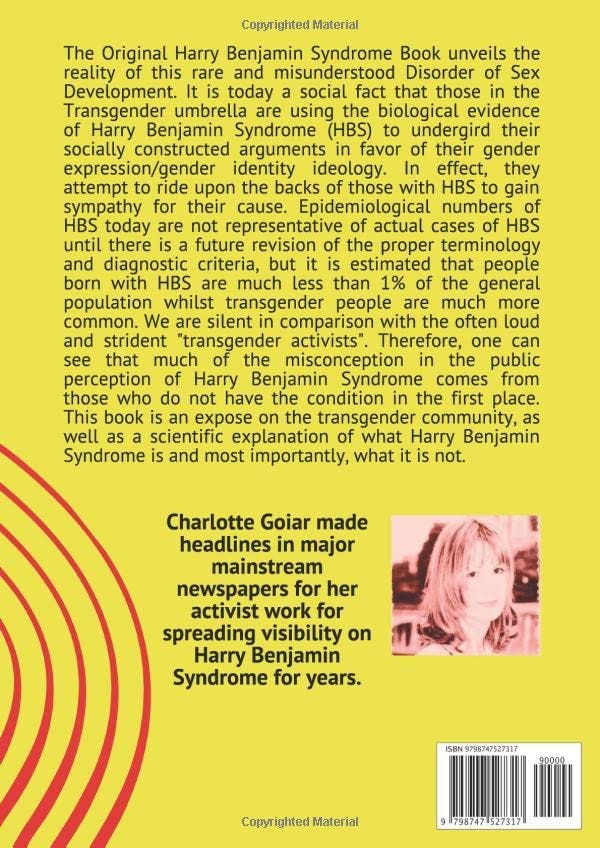
I can picture Christine Burns squirming in his scratchy nylon tights as he listened to an outmoded Gooren give the speech that would ultimately be the death rattle of intersex-brain theory as an activist cudgel. There was a weak attempt to resurrect it a decade later, when a disgruntled Spanish transsexual tried to make Harry Benjamin Syndrome happen. Real transsexualism is akshually a disorder of sex development, claimed Charlotte Goiar. But it was over. The framing put forward by activists like Whittle and Burns would ultimately win the narrative war. We are all living in their world now.
What gender identity means and meant
As we all know (deep weary sigh), gender identity escaped containment long ago, spreading from its medical-theory roots to all corners of contemporary culture. Its supposed supremacy over one’s actual sex in deliberations over sex-based rights, obligations and norms is the garbage-in that has led to so much recent garbage-out.
It is widely understood to mean the inner feeling of being male of female that we’re all supposed to have. But that doesn’t quite fit what it was being described by Money et al.
With some exceptions, in Money’s time, there were two types of people who showed up to clinics claiming to feel a deep incongruence with their inner sexed selves. The first is the Christine Burns prototype: typical male, typical masculine interests, typical (heterosexual) attraction, and typical wife-and-2-kids family setup. Starting around puberty or shortly therebefore, they had begun to notice an attraction to female clothing, behaviour, or anatomy, but directed inwards at themselves.
I won’t go into the gory trajectory, you can read all about it elsewhere. Suffice to say, and this makes me unpopular with some TERFs because it sounds too much like sympathy, but this condition — autogyenphilia, as it was coined by Ray Blanchard in 1989 — seems mighty distressing, despite the highs it occasionally affords. I wouldn’t wish it upon any man (perhaps he could stop wishing it upon me?)
Based on my observations over the past few years in hundreds of private social media sites that cater to these men, I can confidently conclude: the only way is down. Have you ever had an itch that you can’t reach? That’s what they’ve got.
These men were politely referred to as ‘secondary transsexuals’.
Some women are masculine and that’s ok
The other types of people showing up to see the shrinks, the so-called ‘primary transsexuals’, were very ‘feminine’ gay boys and men and very ‘masculine’ lesbian girls and women.
I know these labels are not very popular, and that the progressive thing to do would be to abandon the notions of masculine and feminine altogether because they reinforce the idea that there is a way for a man to be and a way for a woman to be. That’s very nice. But it’s not realistic.
If you’ve ever walked away from meeting a man for the first time and thought to yourself “hmm, seems gay,” or got a jolt of surprise when being introduced to the wife of a man that you had pegged (pegged!) as somewhat twink-like, then we are on exactly the same page, even if yours is buried under a messy pile of progressive shibboleths.
The same goes for that woman who, you can’t help but notice, ‘has a lesbian walk’ or the vibe you get from the sea of grey-haired crew-cut women in comfortable hiking shoes at a WDI conference. Stop pretending you don’t know what I’m talking about.
What is that phenomenon called? Isn’t it funny that in our eagerness to be good little libs, we are left with no acceptable, respectable word with which to describe it? We all have a gaydar, we laugh, but what is the signal that we are picking up? Where’s the noun???
All we’ve got is a few stray adjectives like butch, effeminate, manly, and girly — all of which are controversial, and you would be wise to know your audience’s sensibilities before deploying them.
Transing away the gay
Extreme gender non-conformity, we might call it, or more crudely, one’s degree of observable gay-ishness, seems to be what propelled so much early transsexual research. That thing, whatever it is, appears to be what Money, Gooren and all the others were trying to nail down when they talked about the persistent gender identity mismatch that manifested as ‘true’ or ‘primary’ transsexualism.
This conformity — or not — was also what they looked for when they studied the life outcomes of ‘hermaphrodites’. It was that collection of observable-but-unnamable clues that could tell you whether an XX female born with a large phallus-like clitoris had ‘turned out’ manly or womanly.
Note that the clinicians, when deciding who was truly trans, ruled out not just perverts but also ‘regular’ homosexuals — including gay men who they thought were only artificially camping it up. The true transsexualism label was reserved for people who had a deep discomfort with their own degree of innate gender-bendyness and whose discomfort persisted after puberty.
Indeed, autogynephiles quickly copped on to this, and retrofitted their childhood stories to pretend they had always just loved playing with dolls. But it was all lies. They had memorised the script from the way-too-gays in order to get their hands on that sweet, sweet transsexual diagnosis.
Transsexualism was the endpoint for a child who had acted way-too-gay from an extremely young age, and whose too-gayness could not be ‘fixed’. When gender identity disorder entered the DSM (the official guide for mental health professionals) in 1980, it was applied to kids only, with transsexualism listed as the outcome in adolescents and adults if ‘sissy boy syndrome’ hadn’t been sorted out in the child.
There were varying suggestions as to how to fix this gender non-conformity. Nurture it out of them (John Money), punish and reward the ‘wrong’ behaviour, plus other preventative and corrective interventions, (Robert Stoller and Richard Green), and psychotherapy (Harry Benjamin).
If they couldn’t be rendered less faggy or dykey, then they were good candidates to be synthetically turned into simulacra of the opposite sex.
But to state the obvious, a person’s level of gender discomfort or incongruence is very dependent on the context of the world around them. Money basically admitted this — that these kids’ suffering was not exclusively due to internal causes — when he said that perhaps “de-stereotyping gender roles” would reduce the number of gender non-conforming kids who made it to the other side of puberty still wanting to transition. We can see how the numbers of gay men trying to hide out in womanhood dropped once it became more socially acceptable to be gender non-conforming.
This is the kind of thinking that made it seem totally hunky-dory for Louis Gooren to propose, in a 1996 paper, doing something for little boys to make them ‘pass’ better as female adults — you just had to be sure to pick out the ones who were unlikely to ‘man up’ in the meantime.
It involved nuking these kids’ natural pubertal development, chemically freeze-framing them in a state of permanent sexlessness before completely normal and expected hormonal processes sent them in the ‘wrong’ physical direction. This experiment, which produced the Dutch protocol, infamously actually ended up locking in the identity issues in those who were subjected to it. This would be offered as proof that the right kids had been selected for enrollment.
And this experiment — just to doubleplusgood make sure we all know what a terrible idea it is — is due to be replicated in the UK soon (in 2025!), which is unfathomably barbaric.
It all sounds incredibly homophobic to me.
The birth of intersex activism
Gooren was barely back in the Netherlands and working in his own gender clinic when Money’s was forced to closed down. Fellow clinicians at Johns Hopkins had observed that his prescribed sex change protocol was bogus: very few people who had surgically and hormonally transitioned were better off, quality-of-life-wise. It was shuttered in 1979.
Unfortunately, the discovery that Money was full of shit didn’t extend to the treatment of newborns with genital ambiguities, and his “optimal gender of rearing” idea as it would come to be called, was to persist in practice for many more years to come.
It wasn’t until April 1993, at the exact moment that Stephen Whittle and Christine Burns were faffing around the Low Countries, that Money’s nurture-first theoretical reign over the treatment of disorders of sex development (DSDs) would meet its fiercest resistance yet.
To be continued…
That was part I. The next installment details the beginning of the end of Money’s intersex protocol and the start of intersex activism, and how it ended up getting taken over by radicals (hint: it has a lot to do with brain sex). I’ll also talk about how the LGBTIQ movement worked hard to find and collude with intersex activists to promote both queer theory and trans medicine, how their combined efforts are now affecting the law and producing an entire industry of chancers on the take. Also, I examine the completely legitimate organisations that work to help people born with disorders of sex development, and how attention and resources that they could really use are being redirected to the queer project. Coming soon!
Please take out a paid subscription if you want to read more.
Right at the beginning of your story you miss a very important piece of information that explains a lot but is hardly ever mentioned. You can’t be blamed for that because it has been kept a secret.
There are two universities in Amsterdam, the so-called Free University (Vrije universiteit) and the University of Amsterdam. The (in)famous gender clinic is at the Free University which was founded and funded by a very strict, orthodox and traditional sect of the protestant part of Christianity. They split off from the Dutch Reformed church (Nederlands Hervormde Kerk) and called themself the Reformed Church (Gereformeerde kerk), with the main difference being the belief in predestination. The women do not cut their hair, wear no make-up, do not wear trousers or jeans, women are not allowed to vote or hold public office etc.
The reason they built their own university was to let church members have an academic education without being contaminated with other strains of thinking or other world beliefs.
In a nutshell, the University of Amsterdam, is the opposite; it is left wing, progressive, “woke” we would say now.
That the Free University was foremost in the transgender movement was always baffling, because that was portrayed as being so progressive. The Free University or their gender clinic never clarified their extremely conservative protestant position. Only now that the term “transing the gay away” has become better known, does it become clear what their agenda was all along.
In your article you use the names of the two Amsterdam universities interchangeably, and they must be distinguished as one being extremely right wing and the other left wing. I hope this adds some clarity.
Therefore, because of this hidden idealogical background and motivation, it is important to take every publication of that gender clinic with a handful, not a pinch or a grain, of salt.
An incredible amount of work has gone into producing this text. Repect for, thanks to, researcher - journalist - writer.